
Expansion Joints
Effective expansion joints to accommodate structural movements and prevent damage.
- By ESPT crews
- Supply + install
- Bridge decks and viaducts
- New + replacement
- Movement range
- [± mm]
- Supplied and installed
- KSA · UAE · EG
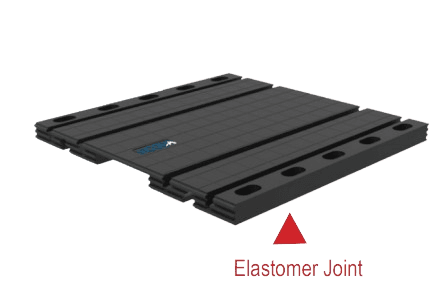
Elastomer Joint
Roadway expansion joints bridge gaps in the carriageway and pavement areas to permit safe traffic passage. They absorb movements without distortion, allowing smooth traffic flow while accommodating bridge movement due to thermal expansion and concrete shrinkage.
Expansion joints are crucial for maintaining the integrity of roadways and bridges, ensuring that traffic flow remains smooth and safe despite structural movements.
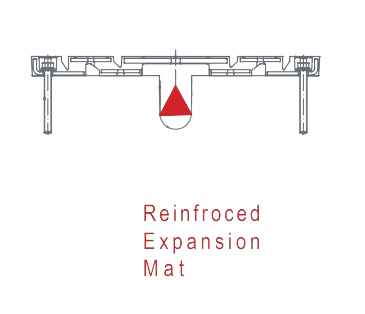
Reinforced Expansion Mat
Reinforced expansion mats, such as the Type S-Flex, are designed to accommodate longitudinal and transverse movements from 50 mm to 320 mm, as well as vertical movements up to 20 mm and rotational movements.
These expansion joints offer a compact and cost-effective solution, ideal for replacements due to their low space requirement and simple installation process.
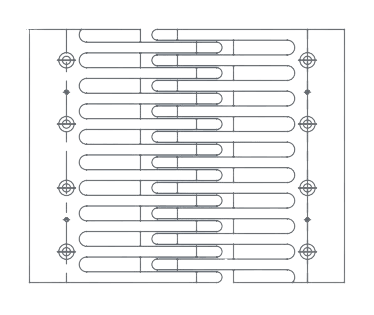
European Approved Finger Expansion Joints
Finger-type expansion joints are engineered to handle longitudinal movements of bridge decks from 50 mm to 1,600 mm. Their robust design supports high traffic loads and provides excellent resistance to material fatigue, ensuring long-term durability.
Roadway Expansion Joint Construction
- 01Without Noise ReductionThe SP expansion joint consists of two parallel steel profiles connected by an elastomer profile, which provides a watertight seal. The joint is anchored into the concrete of the superstructure and abutments for a robust connection with excellent fatigue strength. Suitable for various bridge structures and replacement applications due to its compact installation space.
- 02With Noise ReductionTo reduce noise emissions from roadway expansion joints, the VS-JSR expansion joint features noise-reducing profiles. It includes sinusoidal steel plates that minimize noise when vehicles pass over. This design ensures a quieter driving experience while maintaining the functionality of the joint.
Joint types
Modular Joints
Multiple sealed gaps between steel beams, for large longitudinal movements on long-span decks.
Finger Joints
Interlocking steel plates for medium to large movements with a smooth riding surface.
Elastomeric Joints
Reinforced rubber elements for small movements on short spans and buildings.
Specification data
Values to confirm with ESPT engineering before publishing. Full tables go in the data sheet.
Bracketed values are placeholders- Movement capacity
- [mm per type]
- Traffic loading
- [Load model]
- Watertightness
- [Seal type]
- Design life
- [Years]
- Standard
- [EN / AASHTO reference]
Documents
Discuss your project with ESPT
Send drawings or a BOQ. Your enquiry goes to the office in your country.